Sunday, July 12, 2020

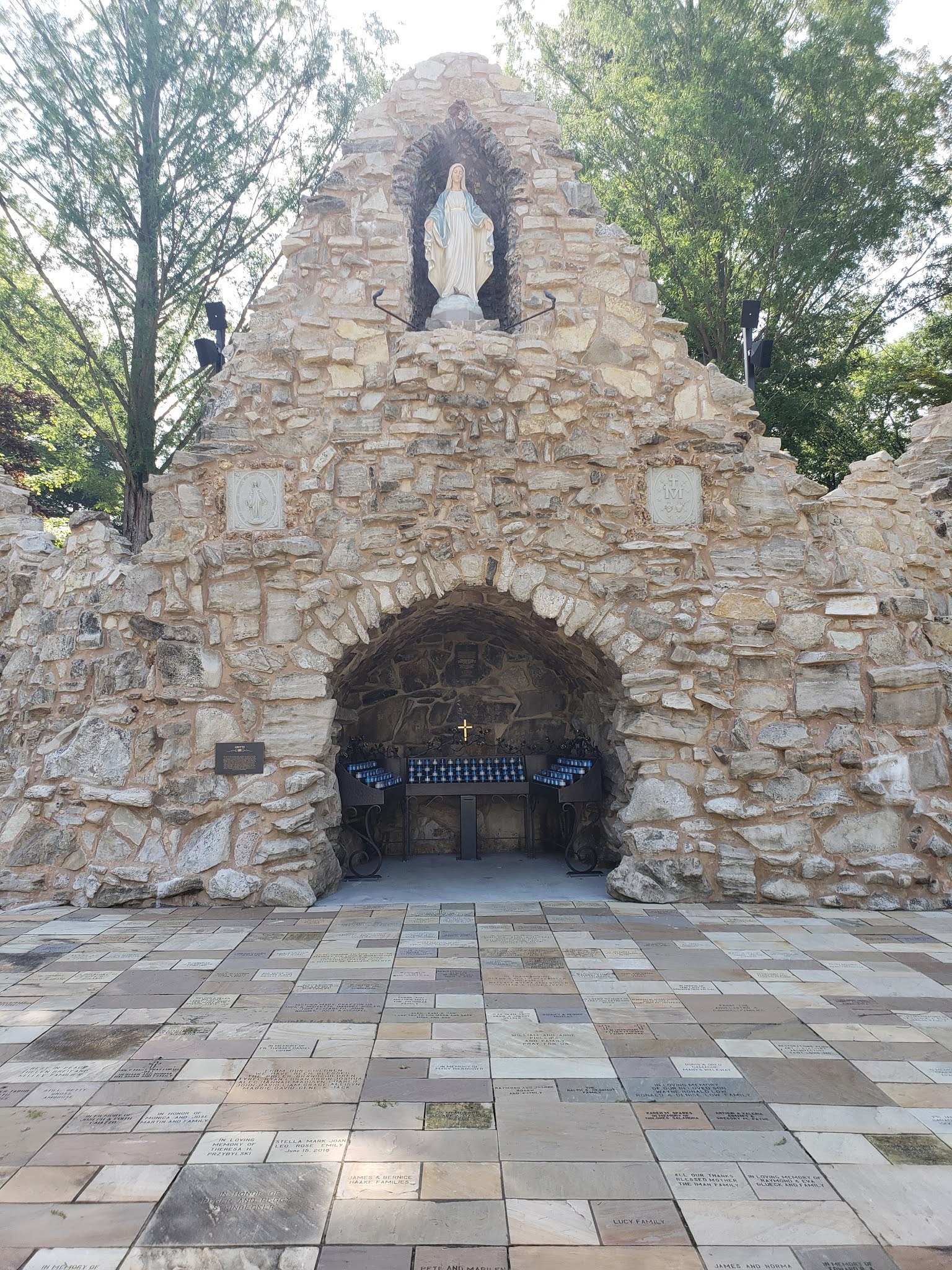
American Pilgrimage: National Shrine of Our Lady of the Miraculous Medal ( Perryville, Missouri)


Some of the best locations for pilgrimages can come in the unlikeliest of places. Tucked away just north of the bootheel in rural southeastern Missouri, is the National Shrine of Our Lady of the Miraculous Medal. It is found in Perryville, MO, the county seat of Perry County, a town with a total population of just 8,440. The nearest City to Perryville is St. Louis, over 80 miles away. The area is about as rural as you can get, and from Indiana at least there is no good way to get there. I was constantly switching county roads on the way down, one of which was as much dirt road as paved. Always fun to drive on, especially at night. Driving alone, it felt like I was in the opening scene of movie about UFO abductions. Fortunately, I made it to my hotel last week without any close encounters along the way. 

So, how does such a rural county in the Bible belt get a National Marian Shrine? Well, unlike most of the other surrounding counties, Perry County is an isolated outpost of Roman Catholicism. Catholics making up 60% of the county’s religious population. The area was originally settled by English Roman Catholics who had fled to the New World from England to avoid religious discrimination, having originally settled in Maryland (the colony founded by Lord Baltimore). In 1818, settlers wrote the bishop and offered land, labor, and materials in return for the construction of a church and seminary, the latter being needed to train priests so the citizens could regularly receive the sacraments. The bishop sent a small band of Vincentian Priests and brothers to do the construction. Originally a small log cabin Church was built but was quickly outgrown. Thus, in 1827 construction began on the present Church which was called “St Mary of the Barren’s Church (see below).


The name "Barrens" comes from the fact that this word is an English word for grasslands. An area more commonly referred to here in the US by the French word "prairie."

Before sharing highlights of the Church and the beautiful garden and grotto area which has a trail through it designed in the shape of a rosary, a brief background on the fascinating story of “Our Lady of the Miraculous Medal” is in order.

HISTORY OF OUR LADY OF THE MIRACULOUS MEDAL


 On 18 July 1830, then Sister Catherine Laboure was living in a Sisters of Charity of St. Vincent de Paul convent in Paris, when one night she claimed to have been awakened by a young child who appeared at her bedside. The child called for her to follow, saying “The Blessed Virgin Mary is waiting for you.” Sr. Catherine got up and followed the child to the Chapel altar, and after a time spent kneeling at the altar rail, the Blessed Mother appeared. As told to her priest confessor Fr. Aladel afterward, Sr. Catherine says Mary revealed certain calamities that were to occur in the future and gave her instructions on how to act in the times of trial ahead. In addition, Sr. Catherine stated Mary expressed to her that she had an important mission for her which would be revealed on a future date. Mary also instructed her to share this information with no one other than her confessor.

On  27 Nov. 1830, Sr. Catherine experienced another and final apparition at the altar. She said Mary appeared to her standing on a globe with a snake underneath it (Note- see Genesis Ch. 3 and Revelations Ch.12 for the Biblical roots of the symbolism), and Mary holding a cross with a smaller globe on top of it. Sr. Catherine attested that the small globe quickly disappeared but then she noticed Mary’s hands being lifted which had jewels on them, some of which shined rays of light, while others did not. Mary explained that the rays symbolized graces given by God and the jewels with no rays symbolized unclaimed graces offered by God. During this apparition, Mary's appearance was outlined in an oval frame with writing inscribed over her that read: “Oh Mary conceived without Sin, pray for us who have recourse to thee.” 

Later, the frame revolved, revealing on the back the letter M surmounted by a cross with a crossbar underneath; and beneath that, the Sacred Heart of Jesus surrounded by a crown of thorns, and the Sacred Heart of Mary pierced by a sword. After this was revealed, Sr. Catherine stated Mary told her to have a medal made in this design and have it spread among the faithful to wear, as it would provide them with special graces.

Fr. Aladel was informed of this immediately but observed Sr. Catherine for 2 years before relaying this incident to the archbishop and requesting production of the medals. He did not even reveal her identity to the archbishop. Long story short, the Medals were made and became a huge success, even without Sr. Catherine’s identity being revealed. Sr. Catherine labored in the convent for 40 years in anonymity, only revealing her connection to the Medal shortly before her death in 1876. In 1933 her body was examined and found to be incorrupt, which is understood by the Catholic Church to be a sign of Sainthood. She was canonized a saint in 1947 and her incorrupt remains are still visible today.

Many miracles were attributed to the medals leading them to be called “The Miraculous Medal.” Accounts of some of the most well-known miracles can be found here:

https://www.americaneedsfatima.org/Miracles/documented-miracles-attributed-to-the-miraculous-medal.html


Of all the miracles attributed in part to the medal, my favorite is the medal’s role in the conversion of an anti-Catholic Orthodox Jew named Alphonse Ratisbonne, who hated Catholicism, especially due to his brother’s conversion. Then, through an odd sequence of events in which he happened to be in possession of the Miraculous Medal, something miraculous happened, that you can read about here:

 https://www.americaneedsfatima.org/Conversions/the-conversion-of-alphonse-ratisbonne.html


VISITING THE CHURCH

On my visit last Friday, I encountered a wonderful tour guide named Robbie who is a walking encyclopedia of the Church and Shrine area generally. He explained the historical development of the Church, which includes within it the actual chapel dedicated as a shrine to the Miraculous Medal. The connection to the medal comes from the fact that the founders of the Church and Seminary were Vincentians, as was Sr. Catherine, a Roman Catholic society established by St. Vincent de Paul. This altar was dedicated in 1930:   

As far as the Church itself, St. Mary of the Barren's served as a Church for the people of Perryville from 1830 until 1965, when a new parish church was built. As the builders of the Church were Vincentians, the Church was modeled after their Motherhouse Church in Rome, and built to 1/3rd of it's scale. Yours truly, the Catholic Legal Beagle is standing in front of the Main Altar depicting the Assumption of Mary below: 


Inside the Church their are eight side chapels with beautiful artwork that primarily serves as a "Whose Who" of the Vincentian Family of priests, brothers, sisters and laity.  I have included a few examples and link to a virtual tour below: 


Anyone interested in a virtual tour of the Church or the Rosary Walk can check out the link below: 


Now let's leave the Church and hit the Rosary Walking Trail! 


HERE IS THE MAP:


`    

After passing through the entrance, you begin your 1/2 mile walk on the rosary shaped path by heading right, where you encounter two separate shrines dedicated to the two apparitions of Mary given to Sr. Catherine Laboure. Going sequentially, the first apparition shows Sr. Catherine at the Altar of the Church, the second shrine depicts Mary as she appeared her at the final apparition:


After this, you proceed on to a log cabin which served as the original sacristy and behind it is a cemetery where the Vincentians buried their clergy who served here for the first 150 years: 


From there the walk takes you to the Grotto, which has at the centerpiece another depiction of Mary as she appeared at the 2nd apparition. From there you go on to see a different statue of Mary, this one placed on top of a mound of dirt built up by the Vincentian priests and brothers for placing a statue of Mary back in the 1850s. Really cool to think about how that mound of dirt has been there since before the Civil War (I am unsure if the present statue is the original).  


The final stop along the tour is a Marian Meditation Circle which has statues replicating some of the most well known Marian apparitions.


CLOSING THOUGHTS 

The National Shrine to Our Lady of the Miraculous Medal is a great place to go for an outdoor rosary and to experience the beauty of God's creation. What I loved most about this place is that though the purpose of the shrine is thoroughly Catholic, seeking to help draw people to God through devotion to Mary and appreciation of the Miraculous Medal, it welcomes people of all faiths and encourages non-Catholics to also be given the Medal. This is due to the Blessed Mother giving an instruction to Sr. Catherine that the Medal should be given to everyone who seeks one, as we are all God's children. A point beautifully illustrated in this painting found inside the Church: 


Finally anyone interested in learning more about the Shrine or paying a visit can learn more here: 

 
FINIS

Sunday, June 7, 2020

Book Review: EAT, FAST, FEAST by Jay W. Richards


Blending ancient Christian eating and fasting habits with keto diet principals, the book "Eat Fast Feast," outlays a dieting program designed to help you lose weight like a 3rd century hermit monk living in the Egyptian desert. Author Jay W. Richards accomplishes more than that however. By exploring the history of the dietary habits of the early Christians and the theological reasons behind them, the author gives the reader more than just a dietary plan. He puts the reader on a path that will enable him or her to use a meal planning cycle of "eating, fasting, and feasting" to draw closer to God. 


History and Theology

"Fasting gives birth to prophets and strengthens the powerful; fasting makes lawgivers wise. Fasting is a good safeguard for the soul, a steadfast companion for the body, a weapon for the valiant, and a gymnasium for athletes. Fasting repels temptations, anoints unto piety; it is the comrade of watchfulness and the artificer of chastity. In wars it fights bravely, in peace it teaches stillness."

                  -St. Basil the Great (4th Century)

St. Basil the Great, 4th Century Bishop of Caesarea

So begins this wonderful book, which for me was the perfect blend of history, theology and practical dietary advice. Why was fasting so important to the early Christians? Well. it was tied to being important for spiritual health, and rooted in the words of Christ himself, who spoke of certain kinds of evil spirits that "cannot be driven out by anything other than prayer and fasting" (See Mark 9: 29).


Fasting was seen by the early Christians as essential for a Christian's spiritual warfare. It was believed that by fasting, one could unite themselves to Christ's suffering which enabled one to grow in holiness, that in turn produced a greater ability to control one's passions (i.e. avoid sin), and ultimately helped one better conform themselves to the will of God. 


 Fasting was much stricter back in the early days than it is today. However, even in the early days the term was understood as being able to refer to periods of both full  abstinence of food, or only partial.  Fasting within Christian communities dates all the way back to the 1st century, where it is first referenced in the earliest non-Canonical Christian document known to exist, called the Didache. Formatted like a Catechism (i.e. collection of Church rules and teachings), it says in part:  


"Do Not Practice fasting with the hypocrites. They fast on Mondays and Thursdays. You should fast on Wednesdays and Fridays. Nor should you pray like the hypocrites. Rather pray as the Lord commanded in the Gospel..." [See Chapter 8, verse 1-2].


Beginning with the celebration of Easter in the first century, Christian communities gradually began to construct what came to be known as a "liturgical calendar," which set aside certain days for fasting (ex: Good Friday), and certain days for celebrating feasts (ex Easter (1st century); Christmas, Feast of the Epiphany (4th century) and martyred Saints on dates of their deaths (added 4th century and thereafter)). Those days where neither fasting or feasting occur were designated as ordinary days to simply "eat."


While fasting has been watered down in Western Christianity to basically just be in effect during the season of Lent, in the Eastern Orthodox and Eastern Catholic communities, the regimen of the originally developed Christian Calendar of the First Millennia remains in in effect for the whole year. Check out this Eastern Orthodox dietary calendar for 2020 (click to enlarge): 


Think you could keep up with these Dietary requirements? Well the Catholic Legal Beagle is going to try, starting on the date of publication of this post! Now, let's turn to what the diet entails.


THE DIET 


In essence, the diet proposed in this book involves a ketonic diet over a period of 46 days, in which a person goes through a cycle of eating, gradual introduction of fasting, then more restrictive fasting, and culminates on the last day with your having a feast and eating whatever you want. Thereafter, this cycle is encouraged to be continued, and the Eastern Christian calendar referenced above is suggested as a road map for guiding one's diet in the future. 


A ketonic diet is a low carb, high fat diet in which your body gets more calories from protein and fat and less from carbohydrates.  The goal is to get your body away from burning sugar as it's primary source of energy, and get your body to begin getting more and more of it's energy from burning fat. The desired end state for your body is for it to be "metabolically flexible." Meaning that your body goes through a process of going from sugar burning to fat burning, to ultimately going though a cycling of both of these processes to achieve weight loss and maintain your body's ideal weight. By the way, the word "ketonic" comes from the term "ketosis" which refers to the process where your body converts fats into ketones, and begins using the ketones rather than sugars for energy. Sugar storage is for most people their primary reason for being overweight, as the body stores it due to our blood streams only being designed to run on 1 teaspoon of sugar a day (One can of Pepsi actually has 8 teaspoons!). 


So in this diet, what does the grocery list look like? Plenty of meats, eggs, salmon for protein; vegetables such as spinach, broccoli, asparagus and kale; natural fat sources such as olive oil, coconut oil and butter; and for snacks, most types of nuts and dark chocolate. Fruit is only recommended on an occasional basis due to being a source of sugar. And what's out? Bread, pastas, soda with sugars, basically everything that tastes good and is not on the approved list seemingly.  


Conclusion and Recommendation. 


The author believes that a diet with plenty of natural fats when combined with fasting, provides a better diet than we now have, which is characterized by grazing and consuming refined grains and sugar. He claims such a diet helps us burn fat, be insulin sensitive, retain muscle, stabilize our moods, and think more clearly. These effects, he claims, will lead us to feeling spiritually renewed, invigorated, disciplined and closer to God. Overall, I absolutely loved this book for providing a fun, well written, dietary plan rooted in history and theology as well as dietary science. So I am going to give this book my highest rating possible, but reserve the right to change it when this diet is over, or whenever I find myself dying of cravings for regular Mt. Dew. Therefore the Catholic Legal Beagle tentatively gives this book a perfect 5 paws out of 5! 


About the Author

Jay W. Richards is a research assistant professor in the Busch School of Business at the Catholic University of America. He has authored many books, including 2010's Money, Greed, and God, which won a Templeton Award. 

Friday, April 10, 2020

The History and Mysteries of Lent (Part 3: Why didn't Pilate let Jesus Go?- The fascinating clue found in the Gospel of John)


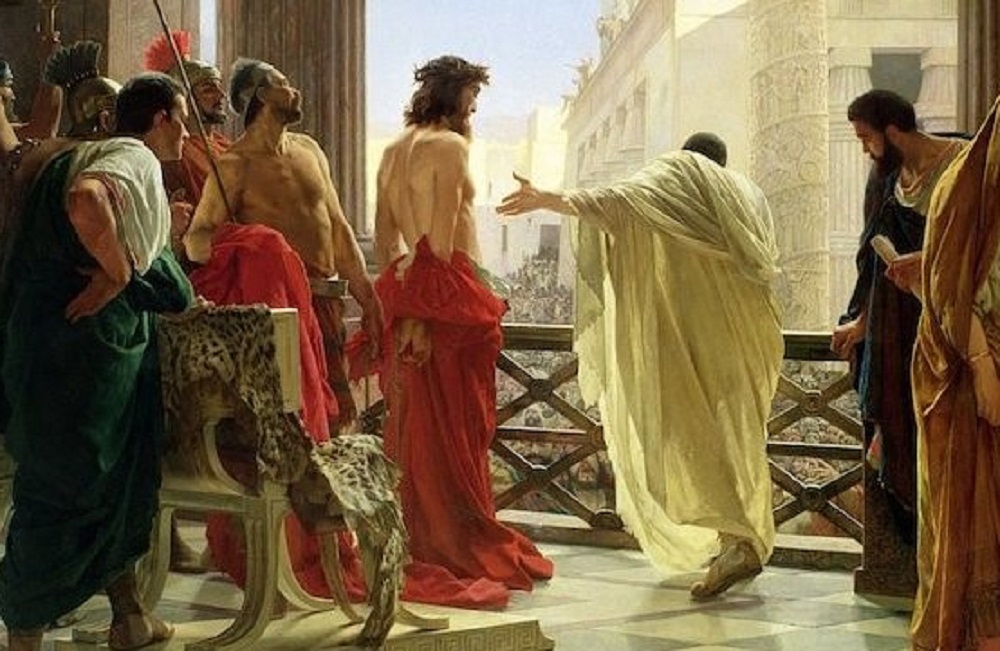
Scholars and Christians alike have wondered why Pilate didn't refuse the demand of the Jews to have Jesus killed? Pilate clearly wanted to, and as Procurator of Judea he certainly had the authority to do so.  While he may have ordered Christ to be crucified at least in part out of wanting to avoid a riot, it's important to remember that Pilate wasn't remembered as someone who seemed to care much for respecting Jewish religious sensibilities. 

Soon after his arrival in 26 AD to take over as Procurator from Valerius Gratius, Pilate infuriated the Jews by marching through the streets of Jerusalem with Soldiers carrying images of the Emperor Tiberius on their standards, a clear violation of the Jewish law against images. Pilate even ordered his Soldiers to kill protestors, but the next day acquiesced and had the images removed. Later, he seized money out of the temple treasury to fund a public works project. This caused a riot, as according to the Jewish historian Josephus, the action violated both Jewish and Roman Law. 

Ultimately, Pilate was recalled to Rome to face a hearing in front of the Emperor Tiberius on allegations of alleged ruthlessness. This resulted from complaints being made to the Syrian Procurator that Pilate allegedly used too much force and caused excessive bloodshed in trying to disperse Samaritans who had gathered at the foot of Mt. Gerizim for a religious service, which for some reason had made Pilate feel threatened. However, when Pilate arrived at Rome Tiberius had died, and nothing is known for sure about him after that. What we do know though, from the Jewish sources at least, is that Pilate was a pretty harsh ruler, even by 1st century standards. 

From the Gospels however, we see a Pilate that is also a very astute politician, and the Gospel of John leaves us a fascinating clue as to why Pilate likely had Jesus put to death. During the trial, Christ initially refuses to answer Pilate's questions, and then the Gospel of John tells us the following (John 19: 10-12):

10 So Pilate said to him, "Do you not speak to me? Do you know I have the power to release you and I have the power to crucify you? 11. Jesus answered, "You would have no power over me if it had not been given to you from above. For this reason they who handed me over to you has the greater sin." 12 Consequently, Pilate tried to release him, but the Jews cried out, "If you release him, you are no friend of Caesar, Everyone who makes himself a king opposes Caesar." 

Biblical Scholars have noted that the phrase "Friend of Caesar" was very pact with meaning in the ancient world. It was an honorific title bestowed upon high ranking officials of merit. During this time it was especially associated with political friends of Lucius Sejanus, who for a long time was the commander of the Praetorian Guard and a most trusted advisor to the Emperor Tiberius. During this time if you were a friend of Sejanus you were considered "A friend of Caesar's." 

Emperor Tiberius (r. 14-37 AD)
Around the time of Pilate's appointment as Procurator of Judea, Tiberius had removed himself to the Isle of Capri, and Sejanus was practically running the Empire from Rome. As Pilate was given a 10 year governorship when the usual term was only one to three years, that is very suggestive that Pilate was appointed by Sejanus and had a close relationship with him. 

Why is all this important? Well, Sejanus fell out of favor with his Emperor in 31 AD and was executed. Tiberius believed Sejanus was plotting against him to further his political ambitions even further. Sejanus's demise was so great that his memory was damned by the Roman Senate, his body hung out in public for abuse, and then thrown into the Tiber river. By 33 AD, most of Sejanus's closest friends and family had been killed. 

If the traditional date of 33 AD for the year that Christ's Passion occurred is accurate, then Pilate would have had reason to be terrified by what was said to him. The prospect of Jewish leaders sending an embassy to Rome to denounce Pilate's actions as Governor of Judea, claiming "Pilate was no friend of Caesar" since he had released a rabble rouser named Jesus who had dared to call himself "King of the Jews," a claim that would disrespected Emperor Tiberius in the region, would have placed Pilate's career and even his life, in very serious jeopardy. Especially if he was a close friend of Sejanus.

This statement would have been seen by Pilate as a threat, even if Christ died earlier, while Sejanus was still at the height of his power. But if this threat was made in AD 33 (or anytime after the fall of Sejanus in 31), Pilate would felt absolutely imperiled.  It should be noted that at the time of the Passover, Pilate would have had up to 3,000 auxiliary Roman troops at his disposal, and certainly showed little fear from the prospect of suppressing riots, both prior to and subsequent to his presiding at Christ's trial.* 

Thus, my conclusion is that it was the not so veiled threat to have Pilate denounced as being "Not a friend of Caesar's," that caused him to yield to the demands of the mob. Pilate did what most politicians did, both then and today. To stay in power he compromised his principles and let a man he believed to be innocent be put to death, then washed his hands as a meager token of protest, ultimately sealing Christ's fate. 


The rest as they is history, but it is also much more than that, it was the price that our loving God made for our salvation. 

* For further reading: See "The Death of the Messiah" by Fr. Raymond E. Brown (1994)

Monday, April 6, 2020

The History and Mysteries of Lent (Part 2: Why did Christ when on the Cross ask God "Why have you foresaken me?")


My own spiritual journey could be characterized as one of conversion, then reversion, with a couple of decades of wandering in the wilderness of doubt in between. Why? Well certain versus really challenged my faith, most of all the one found in Mark 16:34, where just before Christ's death on the cross, he says the following:

"And at three o'clock Jesus cried out in a loud voice, "Eloi, Eloi, lema sabachthani?" which is translated, My God, my God, why have you forsaken me?"


So I kept asking myself: If Christ knew he was the Son of God, and that he had to die on the cross to take away the sins of the world, to redeem humanity for God, why would he have been asking God why he had been forsaken by him? A CS Lewis quote came to mind about how Jesus Christ had to be one of three things: Liar, Lunatic, or Lord. I would ask myself, "Is Christ's asking that question proof that he was just a lunatic?" 

This verse and that question were literally like a cancer attacking my faith. I tried to do some research but my initial efforts were fruitless. Hence, I spent a couple of decades wandering through life as someone who was culturally Christian, but one whose faith felt so meaningless that it was like I was just hanging on with my finger tips and about to fall into the abyss of Agnosticism. 

Ironically, this verse that nearly killed my faith is now one that affirms my faith the most! Why? Well, after doing more research and looking at the verse through the prisms of scriptural prophecy and historical context, I found the answer to my question. And an answer that is just too exciting not to share:) 

PSALM 22: The Compass that led me out of the Wilderness of Doubt. 

What I didn't know then, but do know now, is that when Christ asked that question he was quoting the first verse of Psalm 22. As historians and scripture scholars such as John Bergsma* have noted, the Psalms were not numbered back then as they are today. Instead, when a rabbi was leading a service in a synagogue and wanted to direct attention to a particular Psalm, he would read out the first verse to orient his Jewish listeners as to where in the Psalter (i.e. book of Psalms) he was reading, likely on some occasions to start them singing the Psalm. So why would Jesus call that verse out to the Jews who were watching him die? When you read it you will understand why. 


Reading Psalm 22, one realizes that any Jew present who had caught that reference would have felt like they were watching the events mentioned in that Psalm unfolding in real time. At least up to verses 22-23, where the parallels to Christ's crucifixion are out right startling! Consider the following:


8    All who see me mock me;

they curl their lips and jeer;

they shake their heads at me:

9“He relied on the LORD—let him deliver him;

if he loves him, let him rescue him."

Sound like the scene at the Crucifixion? Compare verse 9 to Matthew 27:43, where the crowd says "He trusts in God, let God deliver him now, if he desires him, for he said "I am the Son of God."

Next consider verses 15-19 in comparison to the Gospels account of Christ's crucifixion:

15 Like water my life drains away;    

all my bones are disjointed.

My heart has become like wax,

it melts away within me.
Compare: John 19:34 "One of the Soldiers pierced his side and at once came out blood and water."


16As dry as a potsherd is my throat;

my tongue cleaves to my palate;

you lay me in the dust of death.

Compare: John 19:38 " Christ says, "I Thirst." 

17Dogs surround me;

a pack of evildoers closes in on me.

They have pierced my hands and my feet
Compare: John 20:25 (Where Thomas states he will not believe Christ is resurrected until he sees where the nails pierced his body). 

18I can count all my bones.

They stare at me and gloat;

19they divide my garments among them;

for my clothing they cast lots.
Compare: Mt. 27-46, Mk. 15:24, Lk, 23:34, and John 19:24, all attesting to how the Soldiers cast lots to distribute Jesus's clothes upon his death.  

Most importantly however, the Jew who knew all of Psalm 22 by heart would have known from there that things take an unexpected and dramatic turn for the better. Let's read this all the way from verse 25 to the end and see how this Psalm ends:


25 For he[God] has not spurned or disdained


the misery of this poor wretch,

Did not turn away from me,
but heard me when I cried out.
26I will offer praise in the great assembly;
my vows I will fulfill before those who fear him.
27The poor will eat their fill;
those who seek the LORD will offer praise.
May your hearts enjoy life forever!”
28All the ends of the earth
will remember and turn to the LORD;
All the families of nations
will bow low before him.
29For kingship belongs to the LORD,
the ruler over the nations.
30All who sleep in the earth
will bow low before God;
All who have gone down into the dust
will kneel in homage.
31And I will live for the LORD;
my descendants will serve you.
32The generation to come will be told of the Lord,
that they may proclaim to a people yet unborn
the deliverance you have brought..

So, why did Christ ask God, "Why have you forsaken me?"  just before he died? To preach! Through His agony, He was calling to the minds of the Jews in attendance to read Psalm 22, and realize they were witnessing the prophecy of Psalm 22 being lived out before their eyes. That through Christ, God was uniting the world under His Kingship, that all generations past, present and future, would enjoy 'life forever,' through the deliverance He had brought!" As the 4th century Church historian Eusebius asks in his Ecclesiastical History, "Who could this Psalm speak to, other than Christ?"  


Psalm 22's remarkable historical prophecy.

While that should be exciting enough to end on, I can't resist adding one more historical footnote that shows how prophetic Psalm 22 really was. Scholars have noted that for the Old Testament Jews, there were four approved methods of Capital Punishment: stoning, burning, decapitation, and strangulation.** Note that none of these involve "piercing of hands and feet" such as is mentioned in Psalm 22:17. No, for that you would need a crucifixion. So hundreds of years before Christ, the author of Psalm 22, inspired by the Holy Spirit, foretold of an eternal life giving deliverance to be accomplished by capital punishment, the methodology of which would have to come from a foreign power (i.e. Rome)! 

What does all this tell me (and hopefully you)? That despite the evils and calamities (ie COVID-19) in this world, we should be assured that there is a God and that He is in control. A God who knew His plan for the Salvation of Man from the beginning, and who showed us His love by offering His Son on the cross. A God who has suffered just as we have suffered, and that the reasons He allows suffering will one day all make sense. And, most importantly of all, that just like with Christ on the cross, we have a God who will never abandon us in our times of darkest despair:)     

* Psalm Basics for Catholics, John Bergsma 
**Capital Punishment in the Bible and Talmudic Law, Haim Hermann Cohn (2008), Encyclopedia Judaica.